Denture implants use dental implants placed in the jawbone to support replacement teeth more securely than traditional removable dentures. Depending on your needs, implant dentures may be removable and snap onto implants, or they may be fixed in place and only removed by a dental professional.
The main types of denture implants include implant-retained overdentures and fixed implant-supported dentures or full-arch bridges. The right option depends on how many teeth you are replacing, your jawbone health, desired level of stability, lifestyle, and budget.
At Dentistry By Design, patients considering dental implants in Midwest City, OK can receive a personalized evaluation to determine which type of implant-supported teeth may best meet their needs.
What Are Denture Implants?
Denture implants, also called implant dentures or implant-supported dentures, replace missing teeth using a prosthetic set of teeth anchored to dental implants.
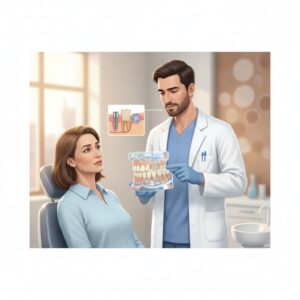
Dental implants are small posts placed into the jawbone. During healing, the implants integrate with the surrounding bone through a process known as osseointegration. Once stable, they can provide support for replacement teeth.
Unlike conventional dentures that rest primarily on the gums, dentures with dental implants receive support from implants anchored within the jaw.
This can provide several advantages, including:
- Greater stability while eating and speaking
- Less slipping and movement
- Improved chewing ability
- Less dependence on denture adhesives
- Stimulation of the jawbone around the implants
- Fixed and removable treatment options
Patients who need to replace an entire arch of teeth can also explore Dentistry By Design’s full mouth dental implant options.
What Are the Different Types of Denture Implants?
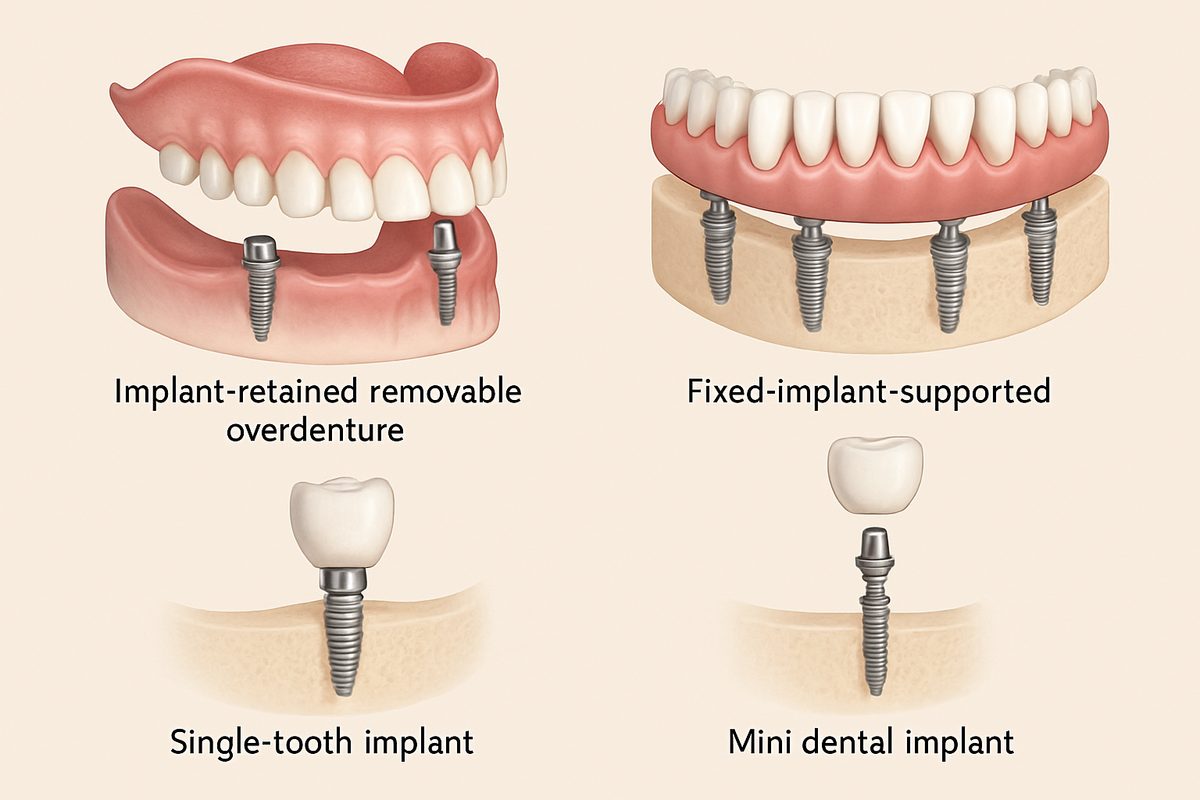
The two primary types of denture implants are removable implant-retained dentures and fixed implant-supported teeth.
The biggest difference is whether you remove the prosthesis yourself for cleaning or the restoration remains secured to the implants.
1. Implant-Retained Removable Overdentures
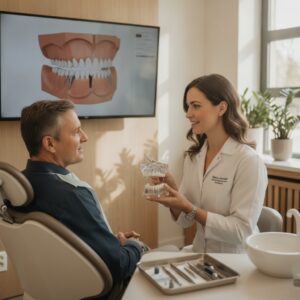
An implant-retained overdenture is a removable denture that attaches to dental implants for additional stability.
Rather than relying only on the gums for support, the denture connects to implants through attachments designed to reduce unwanted movement.
Depending on the patient’s anatomy and treatment plan, multiple implants may be placed throughout the arch.
Potential benefits include:
- More stability than conventional dentures
- Removable for daily cleaning
- Reduced movement while speaking or eating
- Often fewer implants than a fixed full-arch restoration
- Potentially lower treatment cost than fixed teeth
This approach can be particularly useful for patients frustrated by a loose or unstable lower denture.
2. Fixed Implant-Supported Dentures or Full-Arch Bridges
A fixed implant denture or implant-supported full-arch bridge is secured to dental implants and is not removed by the patient.
Instead, the restoration remains in place during everyday activities, including eating, sleeping, and speaking. A dentist can remove the prosthesis when professional maintenance or repairs are required.
Several implants are strategically positioned throughout the jaw to support an entire arch of replacement teeth.
For many patients, the primary attraction is stability. Fixed teeth do not need to be taken out every night like conventional removable dentures.
Dentistry By Design provides full mouth dental implants for patients who need comprehensive tooth replacement.
3. All-on-4® Dental Implants
All-on-4® is a type of full-arch implant treatment that uses four strategically positioned dental implants to support an entire arch of replacement teeth.
Angling certain implants can sometimes make use of available bone in areas where conventional implant placement may be more difficult.
For qualifying patients, a temporary set of fixed teeth may also be attached around the time implants are placed. These are not necessarily the patient’s final teeth; the definitive restoration is typically completed after healing and treatment milestones are met.
Patients interested in this approach can learn more about All-on-4 dental implants.
Are Denture Implants Permanent?
The dental implants themselves are intended to provide long-term support, but whether the teeth are removable depends on the type of restoration.
With an implant-retained overdenture, you remove the denture for cleaning.
With a fixed implant-supported restoration, the teeth remain attached to the implants and are generally removed only by a dental professional.
It is also important to distinguish “permanent” from “never needs maintenance.” Implant-supported teeth still require daily cleaning, professional dental care, and occasional repair or replacement of prosthetic components.
What Is the Difference Between Implant Dentures and Regular Dentures?
The primary difference is how the teeth are supported.
Traditional dentures rest on the gums and underlying tissues. Implant dentures connect to dental implants anchored in the jawbone.
Because of this additional support, implant dentures can provide improved stability and reduce many of the problems patients associate with loose conventional dentures.
| Traditional Dentures | Implant Dentures |
|---|---|
| Rest on the gums | Supported or retained by implants |
| May move while eating | Greater stability |
| Usually removable | Fixed or removable options |
| May require adhesive | Often reduces dependence on adhesive |
| Do not stimulate bone like implants | Implants stimulate surrounding jawbone |
Patients who are unsure which approach is appropriate can compare their options during a dental implant consultation.
Are Dental Implants Good for Lower Dentures?
Dental implants can be particularly helpful for stabilizing lower dentures.
Lower conventional dentures can be difficult to keep stable because of the movement of the tongue, cheeks, and surrounding muscles. Implant retention provides attachment points that can help reduce unwanted movement.
Depending on your anatomy and goals, a lower denture may be supported by a removable implant-retained design or a fixed full-arch restoration.
The number and position of implants needed must be determined through an examination and 3D imaging.
What About Single-Tooth Dental Implants?
Not every patient who has missing teeth needs a denture.
When only one tooth is missing, an individual dental implant can support a dental crown. When several teeth are missing together, implants may support a bridge.
This allows missing teeth to be restored without necessarily preparing neighboring healthy teeth to support a traditional bridge.
Dentistry By Design offers several dental implant options depending on how many teeth need to be replaced.
What Are Mini Dental Implants?
Mini dental implants have a smaller diameter than conventional dental implants.
They may be considered for certain patients or specific applications, including stabilization of some removable dentures. However, they are not simply a smaller substitute for conventional implants in every situation.
The amount of available bone, bite forces, location of the missing teeth, type of restoration, and long-term treatment goals all influence whether mini or conventional implants are appropriate.
A 3D evaluation is necessary before determining which implant design is suitable.
Which Type of Denture Implant Is Best?
There is no single type of denture implant that is best for every patient. The best choice depends on your anatomy, health, goals, and preferences.
Your dentist may consider:
- Number of missing or failing teeth
- Jawbone volume and density
- Gum health
- Overall health
- Desired chewing ability
- Whether you prefer removable or fixed teeth
- Cleaning and maintenance preferences
- Treatment timeline
- Budget and financing considerations
For example, someone primarily concerned with stabilizing an existing removable denture may have very different needs from someone who wants a fixed full-arch restoration.
Advanced imaging can help determine which options are clinically appropriate before comparing their advantages, limitations, and costs.
Fixed vs. Removable Implant Dentures: Which Should You Choose?
For many patients, the decision comes down to removability, stability, maintenance, and cost.
Removable Implant Dentures
These may be appropriate if you:
- Want improved stability over conventional dentures
- Prefer to remove your teeth for cleaning
- Want to explore a treatment involving fewer implants
- Are looking for a potentially more affordable implant-supported option
Fixed Implant-Supported Teeth
These may appeal to patients who:
- Want teeth that remain in place
- Prioritize stability and chewing function
- Do not want to remove a denture each night
- Are comfortable with the additional cleaning requirements around a fixed restoration
Neither solution is automatically better. The goal is to choose the treatment that fits both your clinical needs and your lifestyle.
Do I Need a Bone Graft Before Getting Denture Implants?
Not everyone needs bone grafting before implant dentures.
Dental implants require sufficient healthy bone for support, but modern implant planning can provide several options for patients who have experienced bone loss.
A 3D CBCT scan allows the dental team to evaluate available bone and determine whether implants can be placed directly or whether additional preparation may be beneficial.
If bone volume is insufficient, bone grafting for dental implants may be recommended before or in conjunction with implant treatment.
What Is the Denture Implant Process?
The process generally includes consultation, 3D planning, implant placement, healing, and placement of the final replacement teeth.
Step 1: Consultation and 3D Imaging
Your dentist evaluates your teeth, gums, jawbone, medical history, and treatment goals. Digital imaging helps determine potential implant locations.
Step 2: Preparation
Failing teeth may need to be removed. Some patients may also require bone grafting or another preparatory procedure.
Step 3: Implant Placement
Dental implants are surgically positioned within the jawbone.
Step 4: Temporary Teeth
Depending on your treatment plan and implant stability, temporary replacement teeth may be available during healing.
Step 5: Healing
The implants integrate with the jawbone. Healing time varies based on the procedure and individual patient.
Step 6: Final Teeth
Once appropriate healing has occurred, the final removable denture or fixed restoration is attached.
How Long Does It Take to Recover From Denture Implants?
Initial surgical recovery typically occurs much sooner than complete implant integration.
Swelling, tenderness, and minor bruising can occur during the first several days following implant surgery. Patients are commonly instructed to eat softer foods while the surgical sites begin healing.
The deeper process of osseointegration takes longer and may continue for several months.
Your individual timeline depends on factors such as:
- Number of implants placed
- Whether teeth were extracted
- Whether bone grafting was performed
- Overall health
- Location of the implants
- Type of final restoration
Your dental team will provide specific instructions and monitor healing throughout treatment.
Can I Be Sedated for Denture Implant Surgery?
Sedation may be available for patients undergoing dental implant procedures.
Dentistry By Design provides sedation dentistry options for qualifying patients who are anxious about treatment or undergoing more extensive procedures.
The appropriate level of sedation depends on your medical history, procedure, and individual needs.
How Much Do Denture Implants Cost?
The cost of denture implants varies because treatment can range from stabilizing a removable denture with implants to replacing an entire arch with fixed implant-supported teeth.
Factors affecting cost can include:
- Number of implants
- Removable versus fixed restoration
- Number of arches treated
- Tooth extractions
- Bone grafting
- Sedation
- Materials used for the final teeth
- Complexity of the case
Because the treatment possibilities are so different, a personalized examination provides a more useful estimate than a single advertised price.
Patients can learn more about dental implant costs and affordability before scheduling an evaluation.
Does Insurance Cover Implant Dentures?
Coverage depends on your individual dental insurance plan.
Some policies may contribute toward portions of treatment while excluding or limiting coverage for dental implants themselves. Annual maximums, waiting periods, missing-tooth clauses, and other policy restrictions can also affect benefits.
Ask for a detailed treatment plan so you can understand both the total treatment cost and any estimated insurance contribution.
Dentistry By Design also provides information about insurance and financing for patients exploring ways to make treatment more manageable.
Denture Implants in Midwest City, OK
Choosing between traditional dentures, removable implant dentures, and fixed implant-supported teeth is an important decision. Understanding the differences can help you ask better questions and determine what you value most from treatment.
Dentistry By Design provides comprehensive dental implant treatment in Midwest City, OK, including options for patients who need to replace a single tooth, several teeth, or a complete arch.
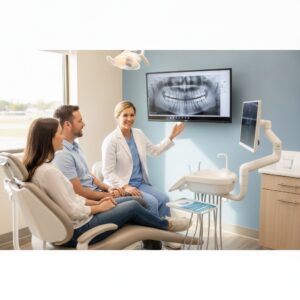
During your consultation, the team can evaluate your jawbone with advanced imaging, discuss fixed and removable options, explain whether preliminary procedures are necessary, and develop a personalized treatment plan.
If loose dentures, widespread tooth loss, or failing teeth are affecting your ability to eat and smile comfortably, schedule a consultation with Dentistry By Design to find out which type of denture implant is right for you.