
Mouth dental implants are a full-mouth approach to replacing missing or failing teeth using dental implants and implant-supported prostheses. Patients who ask about a full-mouth replacement often want better chewing, a natural look, or to stop the cycle of dentures that slip. This article explains what mouth dental implants are, the main options, who is a good candidate, the treatment steps, risks and benefits, cost factors, and how to take the next step.
What “mouth dental implants” mean
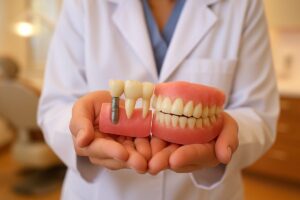
Dental mouth implants are treatments that restore an entire arch—or both arches—of teeth using implant-supported solutions rather than single crowns. Full-arch solutions include All-on-4®, full-arch implant bridges, and implant-supported dentures. Single-tooth implants replace a single tooth. Patients will often hear terms like “implant bridge,” “fixed full-arch,” or “overdenture”—all describe ways implants anchor new teeth to the jaw.
Common types of dental implants
All-on-4® full-arch restorations
All-on-4® uses four strategically placed implants to support a full fixed arch. Many patients receive immediate temporary teeth the same day, with final restorations placed after healing. This works well for people who want a fixed solution and have enough bone for stable implant placement.
Implant-supported bridge (multiple implants)
When additional support is needed, several implants (more than 4) can support a bridge or partial arch. This provides stability and may be chosen when bone volume or bite forces require additional support beyond four implants alone.
Individual implants for every tooth
Replacing every missing tooth with its own implant gives the most natural load distribution and long-term control, but is more complex and costly. An implant bridge uses fewer implants to restore many teeth, often balancing cost and function.
Who is a good candidate for mouth dental implants?
Oral and bone health considerations
Good candidates have healthy gums and enough jawbone to support implants. If the bone is thin, bone grafting or sinus lifts can rebuild the structure. Gum disease must be treated before implant surgery for the best outcome.
Medical and lifestyle factors
Controlled diabetes, non-smoking, and stable health improve success rates. Smoking, certain medications, or uncontrolled medical conditions raise risks. Discuss habits and meds honestly during evaluation.
Age and long-term goals
Adults at many ages can benefit, but implants require a commitment to oral care and regular dental visits. People wanting a permanent, natural-feeling solution often choose dental implants.
The treatment process and expected timeline for mouth dental implants
Consultation and digital planning
Care begins with exams, 3D scans, and digital planning. These tools map bone, nerves, and ideal implant positions for predictable results.
Surgery, temporary teeth, and healing
Surgery places the implants. Many patients receive immediate temporary teeth when stability allows. Osseointegration—the bone fusing to the implant—takes weeks to months and requires follow-up visits.
Final restoration and maintenance
After healing, the final prosthesis is attached. Ongoing hygiene, regular cleanings, and occasional adjustments keep implants healthy for years.
Benefits, risks, and recovery expectations
Key benefits
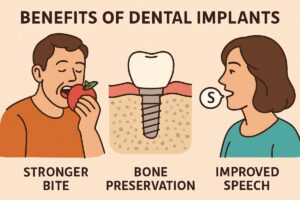
Dental implants restore chewing, speech, and appearance while preserving bone and facial structure, compared with traditional dentures.
Potential risks and complications
Risks include infection, implant failure, and nerve issues. Careful planning and experienced surgical teams reduce complications.
Typical recovery timeline
Expect a few days of soreness managed with meds, a soft-food diet for a few weeks, and a gradual return to normal bites over months as implants integrate.
Cost factors and payment options for mouth dental implants
Major cost drivers include the number of implants, bone grafting, materials, and lab work. Insurance often limits coverage for implants, but financing options like CareCredit, Cherry, and Proceed Finance help make treatment affordable.
Why choose Dentistry By Design for mouth dental implants
For dental implants in the mouth in Midwest City, Dentistry By Design offers All-on-4®, digital planning, in-house surgical suites, sedation options, and same-day CEREC® workflows. Their team provides start-to-finish care with modern tools and patient-focused service.
Next steps: How to learn if mouth dental implants are right for you
Schedule a consult with digital imaging. Bring your medical history and any current dentures, and ask about financing and sedation. A clear exam and plan will show whether dental implants in the Midwest City area are the right path for your smile.