
Dental implants full mouth refers to replacing an entire upper or lower arch—or both—with implant-supported teeth. This guide is for anyone considering a full-arch solution and addresses common questions regarding available options, candidacy criteria, the treatment timeline, pain and recovery expectations, potential risks, cost considerations, and next steps for full mouth dental implants in Midwest City, OK.
What “dental implants full mouth” actually means
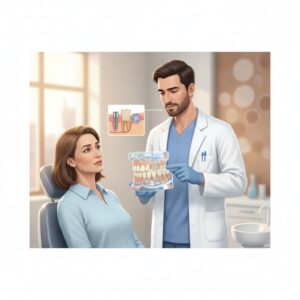
Full-mouth solutions are designed to replace many or all missing teeth within a dental arch using implant-based restorations. Common approaches include All-on-4, implant-supported bridges, and hybrid dentures. Unlike a single-tooth implant, full-mouth reconstruction aims to restore chewing function, speech clarity, and facial support by replacing multiple teeth concurrently.
Who is a good candidate for full mouth dental implants?
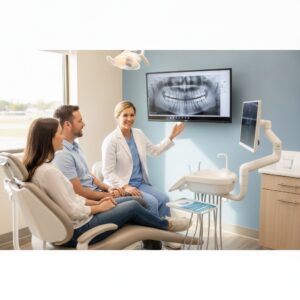
Considering candidacy involves evaluating both oral and overall health factors. Good candidates typically have controlled medical conditions, establish healthy gum tissue, and possess sufficient jawbone density to support dental implants. If bone density is insufficient, procedures like bone grafting or other bone augmentation alternatives may be recommended. A thorough dental examination, often including 3D scans, helps verify bone volume and identify any existing infection before treatment proceeds.
Lifestyle and expectations
Patients who do not smoke or are willing to cease smoking generally experience better long-term outcomes for their implants. Well-managed diabetes and a consistent commitment to oral hygiene practices are also important for successful integration and longevity. It is helpful to maintain realistic expectations: full-mouth dental implants restore significant function and appearance, but they require ongoing maintenance and diligent regular dental visits.
Full-mouth implant options and how they differ
Several options exist for full-mouth dental implants, each with distinct characteristics.
All-on-4 and immediate-load options
All-on-4 utilizes four strategically placed dental implants to support a full arch of teeth. This approach can often provide temporary teeth on the same day as implant placement. This immediate-load method allows patients to have functional teeth quickly while the dental implants gradually integrate with the jawbone, a biological process known as osseointegration.
Implant-supported bridge vs. hybrid denture
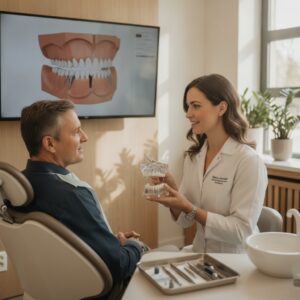
An implant-supported bridge is a fixed prosthesis that is permanently cemented or screwed onto the implants, designed to feel much like natural teeth. A hybrid denture also sits on dental implants but may be removable by a dentist for professional cleaning and maintenance. Dental bridges typically offer a more solid and stable feel; hybrid dentures can often be a more cost-effective solution and may be simpler to repair if damage occurs. The choice between these options depends on individual needs, oral health, and preferences.
Treatment timeline and what to expect during care
The treatment process typically begins with a comprehensive consultation involving exams and digital planning. This is followed by a surgical procedure to place the dental implants and, in some cases, temporary teeth. Osseointegration, the critical process where the bone fuses directly with the dental implants, usually takes several months. During this healing period, temporary teeth are worn. Once the implants have achieved stable integration, the final custom-fabricated prostheses are placed.
Pain, sedation, and recovery
To ensure patient comfort during procedures, various sedation options are available, ranging from nitrous oxide to intravenous (IV) sedation. Normal recovery can involve swelling, mild soreness, and a recommendation for a soft-food diet for several days to weeks post-procedure. Adhering to post-operative instructions, applying ice packs to manage swelling, and taking prescribed medications are essential for a smooth recovery. Patients should contact their dentist for concerns such as fever, severe or worsening pain, or any unusual drainage from the surgical sites.
Risks, longevity, and maintenance
Short-term risks associated with dental implant surgery include infection at the surgical site and the potential for dental implant failure. Long-term success largely depends on consistent oral hygiene, abstaining from smoking, and undergoing regular dental checkups. With proper care and maintenance, full-mouth dental implants can last for many years; however, some components may require periodic repairs or replacement over time.
Cost, insurance, and financing options
The total cost of full-mouth dental implants varies based on several factors, including the chosen implant method, the number of implants required, the need for bone grafting procedures, and the materials used for the final restoration. While some dental insurance plans may cover portions of the treatment, such as extractions or certain types of crowns, comprehensive coverage for the entire full-mouth dental implant procedure is often limited. Patients frequently explore third-party financing options like CareCredit or Proceed Finance, or inquire about potential in-house payment plans to manage the cost of full mouth dental implants in Midwest City, OK.
Why choose Dentistry By Design for full mouth dental implants?
Dentistry By Design offers advanced in-house capabilities, including digital planning, CEREC same-day solutions for certain restorative components, and an on-site surgical suite equipped for various sedation options. Our two-generation doctor team brings extensive experience in All-on-4 procedures and comprehensive full-mouth reconstructions, providing coordinated care from initial consultation through treatment completion. We are committed to guiding patients through each step of their tooth replacement journey.
Considering Full-Arch Dental Implants in Midwest City? Get Started Today
We recommend preparing for your initial consultation by bringing a list of current medications, any recent relevant x-rays you may have, and a list of questions or concerns. During this appointment, you can discuss dental implant options, expected timelines, sedation choices, and available financing. Contact us to schedule a digital planning appointment to evaluate if full mouth dental implants in Midwest City, OK are the right solution for your oral health needs.